
Quick answer: A new roof costs $9,612 on average in 2026, and most homeowners pay between $5,903 and $13,381, according to Angi’s data from nearly 33,000 real projects. Per square foot, expect $4 to $11 installed. Asphalt shingles sit at the cheap end, metal and tile in the middle-to-high range, and slate at the top. Your real number depends mostly on three things: how big your roof is, what you cover it with, and how complicated it is to work on.
Roof quotes are famous for their spread. The same house can draw one bid at $8,400 and another at $15,000, and both contractors can be telling the truth about their own price — they are just pricing different materials, different tear-off assumptions, and different ideas about what “the job” includes. This guide lays out what a roof actually costs in 2026, line by line, so you can tell a fair quote from an inflated one.
The average cost of a new roof in 2026
The most-cited figure comes from Angi, which surveys what homeowners really paid: $9,612 on average, with the middle of the market between $5,903 and $13,381. Other trackers land in the same neighbourhood. Fixr puts a typical replacement at about $10,000 (most jobs $7,500 to $14,000). This Old House, pricing a 2,000-square-foot asphalt roof specifically, lands at $10,319.
Why don’t the sources agree exactly? Because each one is averaging a different mix of roofs. A survey dominated by small ranch houses produces a lower “average” than one full of two-storey homes with steep, cut-up roofs. Treat $9,500–$10,500 as the honest national middle for a typical asphalt roof on a typical house — then adjust for your material and size using the tables below.
New roof cost by material
Material is the biggest single decision in the price. Here is what each common option costs installed, per square foot of roof, and what that means on a 2,000-square-foot roof (about 20 squares — a square is 100 square feet of roof surface).
| Material | Installed cost per sq ft | On a 2,000 sq ft roof | Typical lifespan |
|---|---|---|---|
| Asphalt shingles (3-tab) | $3–$7 | $6,000–$14,000 | 15–20 years |
| Architectural shingles | $4–$6 | $8,000–$12,000 | 25–30 years |
| Metal (panels / standing seam) | $7–$13 | $14,000–$26,000 | 40–70 years |
| Wood shakes | $6–$13 | $12,000–$26,000 | 25–40 years |
| Clay / concrete tile | $10–$20 | $20,000–$40,000 | 50+ years |
| Slate | $15–$30 | $30,000–$60,000 | 75+ years |
Per-square-foot ranges are HomeAdvisor’s 2026 figures; the middle column is those rates applied to a 2,000 sq ft roof. Two things stand out. First, architectural shingles cost barely more than basic 3-tab but last roughly a decade longer and hold up better in wind — for most houses they are the value pick, and they are what most roofers quote by default. Second, metal costs about double asphalt up front but lasts two to three times as long, so the per-year cost is closer than the sticker suggests. Tile and slate only make sense where the structure can carry the weight and the style fits the neighbourhood — and slate needs a roofer who actually works with stone, which narrows your choice of contractor.
Cost by roof size
Roofers price by the size of the roof itself, not the size of the house — and the roof is bigger than the floor plan. Pitch and overhangs mean a 1,500-square-foot one-storey house might carry 1,700–1,900 square feet of roof. Angi’s 2026 figures by roof area:
| Roof size | Average cost range (all materials) |
|---|---|
| 1,120 sq ft | $4,900–$12,300 |
| 1,565 sq ft | $6,800–$17,200 |
| 1,790 sq ft | $7,800–$19,700 |
| 2,235 sq ft | $9,700–$24,600 |
| 3,805 sq ft | $16,600–$41,900 |
The wide ranges within each size are mostly material: the low end is asphalt, the high end is metal, tile or a complicated roof. If a quote lands far outside the band for your roof size, that is worth a question — not automatically a rejection, but a question.
The extras that push a quote up
The shingle price is only part of the bill. These are the lines that separate a $9,000 quote from a $13,000 one on the same house:
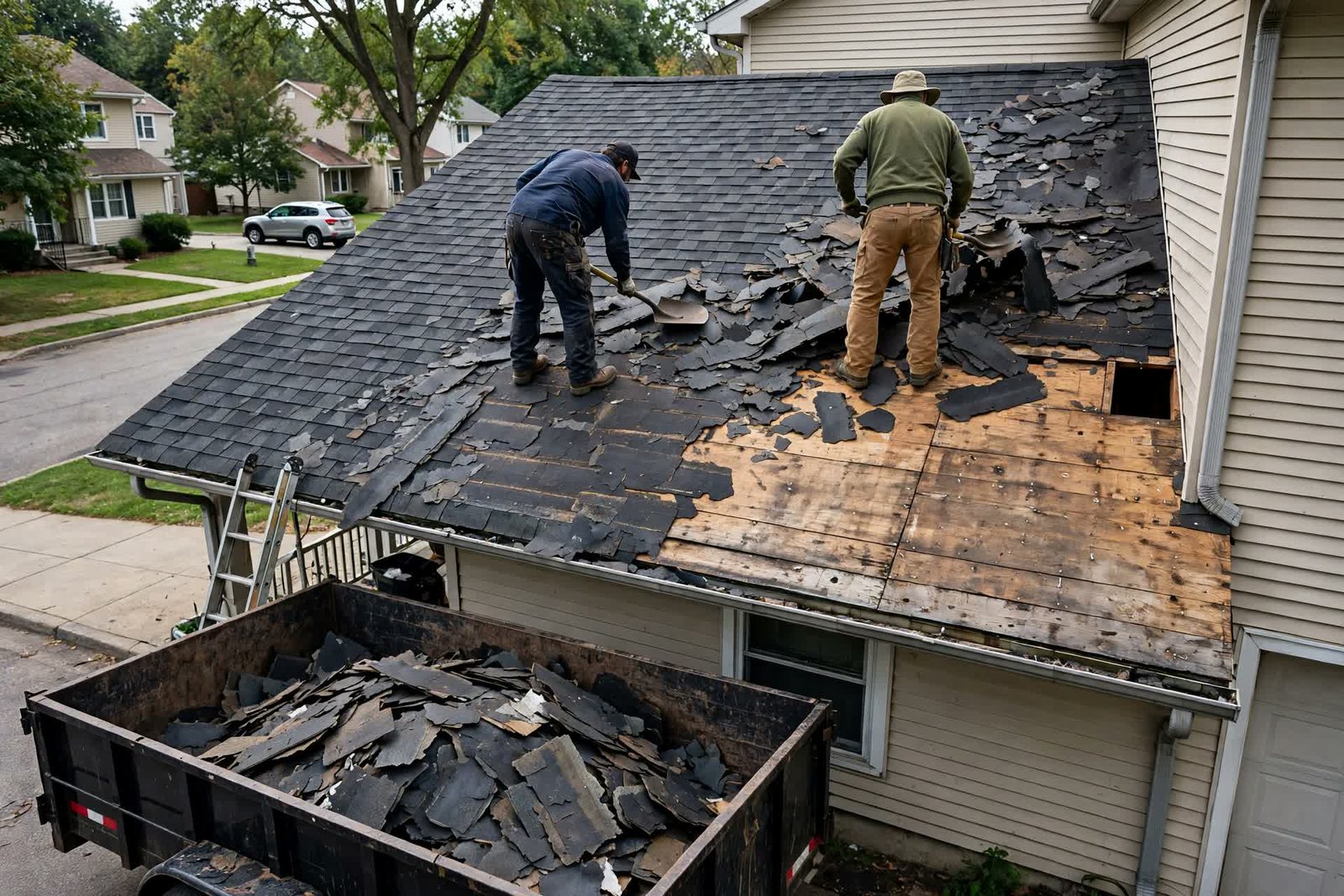
Tear-off and disposal — $1,500 to $4,500. Removing the old roof and hauling it away is real labour and real dump fees. A quote that assumes laying new shingles over the old (an “overlay”) looks cheaper, but most roofers advise against it: it hides deck damage, adds weight, and many local codes limit roofs to two layers anyway.
Steep or complex roofs — add $1,000 to $3,000. A steep pitch needs more safety equipment and slower work. Hips, valleys, dormers and skylights all add cutting, flashing and time.
Decking repairs — varies. Once the old roof is off, rotten or soft decking sometimes appears. Replacing a few sheets of plywood is normal and usually priced per sheet; a quote should state that rate up front so there is no surprise mid-job.
Permits — $100 to $1,400. Most cities require a permit for a full replacement. It is a small line, but a contractor who suggests skipping it is telling you something about how they work.
Underlayment and ice protection. In cold states, an ice-and-water shield along the eaves is often code. In hurricane regions, sealed decking and upgraded fasteners add cost — and may earn an insurance discount, which is worth asking about.
Why your neighbour paid a different price
Labour is roughly half the cost of a roof, and labour markets are local. The same job priced in rural Mississippi and suburban Boston can differ by 40% or more without anyone overcharging. Timing matters too: after a major storm, every roofer in the area is booked and prices firm up; in the quiet season — late autumn and winter in many regions — some companies will negotiate to keep crews working. Finally, check what the warranty actually covers. A cheap quote with a two-year workmanship warranty and a pricier one with a 10-year workmanship warranty plus a manufacturer-backed material warranty are not the same product.
Repair it or replace it?
Replacement is not always the answer. As a rough guide: an asphalt roof under 15 years old with one localised leak is usually a repair. A roof past 20 years with curling shingles, granules washing into the gutters, several leaks or soft spots in the deck is telling you it is done — money spent patching it is money you will not get back. Metal and tile roofs rarely need full replacement before 40 years; their failures are usually at the flashing, which is fixable. If you are unsure, a standalone roof inspection costs around $240 on average and is cheaper than guessing wrong in either direction.
How to get a fair price
Get three written quotes, and make sure each one itemises the same things: tear-off, underlayment, material by brand and line, flashing, ventilation, decking rate per sheet, permit, and cleanup. Quotes you can compare line by line are quotes that keep everyone honest. Check the licence and insurance certificate yourself rather than taking a verbal “we’re covered.” Never pay the full amount up front — a deposit for materials, progress payments, and the balance on completion is the normal shape of a fair deal. And if a price seems too good to be true against the ranges above, it usually means something has quietly been left out of scope.
The ranges in this guide come from Angi’s roof replacement cost data (updated October 2026, based on 32,999 projects), HomeAdvisor’s 2026 pricing and Fixr’s 2026 guide, all checked in November 2026. They will get you within range of a fair price — but the only number that counts is a written quote on your own roof, measured by someone who has stood in your driveway. For more guides like this one, see our Roofing Costs section.